
Mistral is NOT a European Alternative (Yet) - Here’s Exactly Why
Why a Paris headquarters doesn't equal data sovereignty, and how your chats are still feeding and funding US Big Tech
Disclaimer: This article is aimed at regular users, who make up 90% of Mistral's user base and use the Chat (Le Chat) or API. It is not intended for users who self-host Mistral, nor for companies and governments with infinite budgets who use Mistral's custom plans.
This is the article that Mistral superfans and their venture capital backers are desperate to keep off your news feed, and they are trying to censor it. Buckle up, because we're about to reveal the truth they're trying to hide. Defy censorship! Share the article below to make your friends and family aware that they haven't just switched to a European alternative, and to keep the truth visible against the algorithm.
Before we dive into the technicalities, let’s give credit where it’s due: Mistral is a powerhouse. They have proven that a lean team from France can compete with the silicon giants of California. Their models are world-class, their commitment to open weights is commendable, and their multilingual performance is arguably the best in the game.
However, we need to stop confusing "European Founded" with "European Sovereign". As of January 31, 2026, if you are one of the 90% of users using Mistral’s web interface or API, you are not using a European alternative. You are using a US-dependent service with a French coat of paint.
The "Default" Privacy Trap
Many users flock to Mistral thinking they’ve escaped the data-hungry maws of Silicon Valley. In reality, Mistral’s default settings often allow chat data to be used for training. If you haven't manually toggled those settings, your private prompts are being read and processed by trainers to refine future models.
To be clear: Internal model training does not inherently disqualify a company from being "sovereign", but this distinction is critical. Most users, assuming a "European" label implies superior privacy by default, feed sensitive personal and corporate data into these chats without ever questioning how that information is harvested or retained. This is the exact same data-harvesting model used by OpenAI and Google.
The US Backbone: Where Your Data Actually Goes
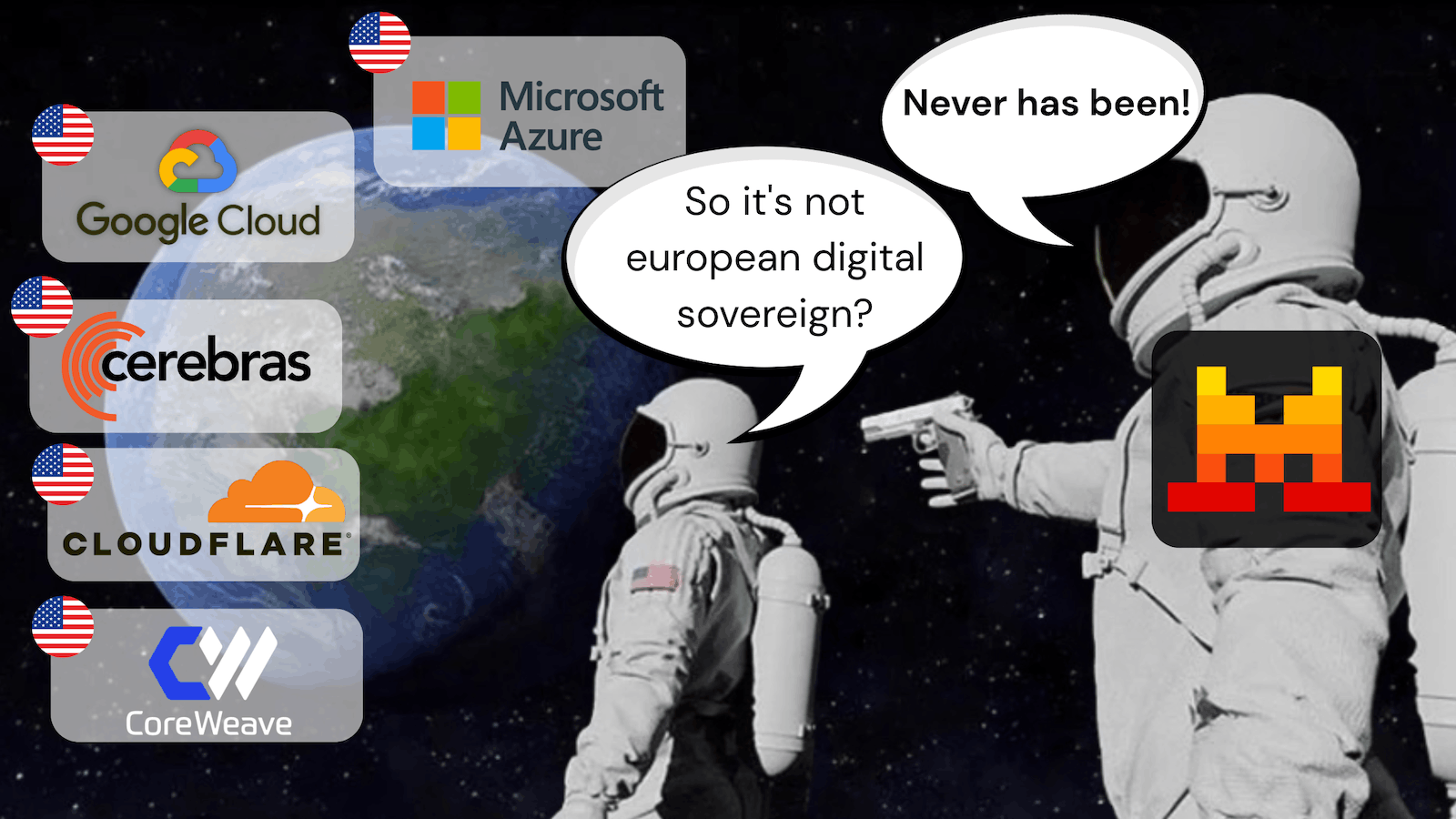
A company is only as sovereign as the servers it runs on. Mistral’s architecture doesn't sit in a fortress in Paris; it relies on a distributed network of US Big Tech.
When you send a prompt, you are effectively playing a game of jurisdictional Russian Roulette. Depending on the model you select and the current load balancing, your data is routed to one of several American heavyweights for processing:
-
Microsoft Azure: Thanks to Mistral’s "premium" partnership, their flagship models are heavily hosted on Azure infrastructure. Whether you are using the web chat or the standard API, a significant portion of that traffic is processed directly on Microsoft’s servers.
-
Google Cloud (Vertex AI): Specific capabilities, particularly OCR (reading text from images) and certain model deployments, are routed through Google’s ecosystem. If you use features dependent on this stack, your content is effectively taking a trip to Google Cloud.
-
CoreWeave: A US-based specialized cloud provider often used for heavy inference workloads. Your requests (chats) could be processed on their GPU clusters, adding another US entity to the data chain.
-
Cerebras: The lightning-fast "Flash" responses? Those are processed by hardware managed by US-based Cerebras. Your chats are sent there.
The "Gatekeepers": Even Before You Chat
Before your prompt is even processed, you have already entered US jurisdiction just by loading the website:
-
Netlify: The actual website interface, the "doorway" where you type your message, is hosted by Netlify, a San Francisco-based cloud company. While they may not process the AI inference itself, they control and log the delivery of the application to your browser.
-
Cloudflare (The Silent Tracker): This is perhaps the most overlooked risk. Every time you click, your IP address, device fingerprint, and browsing behavior are logged by Cloudflare (US) before they ever reach the next server in line.
The Cloudflare Reality: Because Cloudflare sits in front of approximately 20% of the entire web, they possess the unique capability to monitor your browsing habits across millions of different websites. Unlike a standard ISP that only sees connection requests, Cloudflare decrypts and inspects the traffic. By using Mistral, you are feeding more data points into this massive, centralized US surveillance network, often without realizing that the same company protecting Mistral is likely watching you on thousands of other sites you visit daily.
For reference, you can find a partial list of their subprocessors here: Mistral's shortened subprocessor list
The Legal Reality: Under the U.S. CLOUD Act, it doesn’t matter if your data is processed on a server physically located in Paris, Sweden or Norway. If a US company (like Microsoft, Google, or Cloudflare) controls that server, the US government has a legal pathway to access that data any time they want.
Should either of the above US companies suffer a catastrophic failure or unilaterally terminate service, Mistral faces an immediate total blackout. This fragility was demonstrated already on November 18, 2025, when a Cloudflare failure resulted in a three-hour outage for Mistral, and again on December 5, 2025, when the same dependency caused a 25-minute service interruption. Let that sink in.
This analysis could go much deeper. We haven't even detailed secondary processors like Intercom, a US-based partner hosted on AWS that automatically transmits user metadata to Amazon CloudFront. For the sake of brevity, we will stop here, though the data trail continues.
The Wall of Silence: Censorship & Evasion
This isn't just about technical architecture; it is about narrative control. Try posting these facts in 'European Alternatives' forums or Reddit communities, and watch the reaction. Posts are frequently deleted, shadow-banned, or aggressively downvoted. This resistance often comes from users and investors who are deeply entrenched in the Mistral ecosystem, desperate to protect the 'European AI' valuation while battling the cognitive dissonance of realizing their 'sovereign' choice is actually US-dependent. They want you to believe the flag on the website, not the servers in the basement.
Even major European players remain silent on this issue:
- When Qwant, the search engine championing European data sovereignty, publicly urged users to switch from ChatGPT to Mistral for 'European data sovereignty reasons', we reached out. We asked a simple, technical question:
"How can you recommend Mistral for sovereignty when its entire operation depends on Google, Cloudflare, Microsoft, and CoreWeave?"
Their response? Silence. Despite multiple attempts to get a clarification on how this dependency aligns with their privacy claims, they refused to address the architectural reality. See the proof here. (Important: This link will redirect you to X, formerly Twitter.)
The Ownership Dilemma: Who Actually Owns the Ship?
It’s not just about where the data flows; it’s about where the money goes. While we celebrate Mistral as a European champion, we must look at the cap table. Their biggest strategic backers include American giants and VCs:
- Microsoft
- NVIDIA
- Andreessen Horowitz (a16z)
- Salesforce
When you pay for Mistral today, you aren't just funding French innovation; you are validating the investment thesis of Silicon Valley. Using Mistral currently supports the US more than it builds Europe. It’s a harsh truth, but you need to wake up to the financial reality.
Rebuttal: Is "Perfect" the Enemy of the "Good"?
Whenever these facts are brought up, a specific group of critics, often suffering from a bit of cognitive dissonance, defends the status quo. You’ll hear arguments like: "Perfect is the enemy of the good. Stop being a purist. This mentality is how you kill European companies".
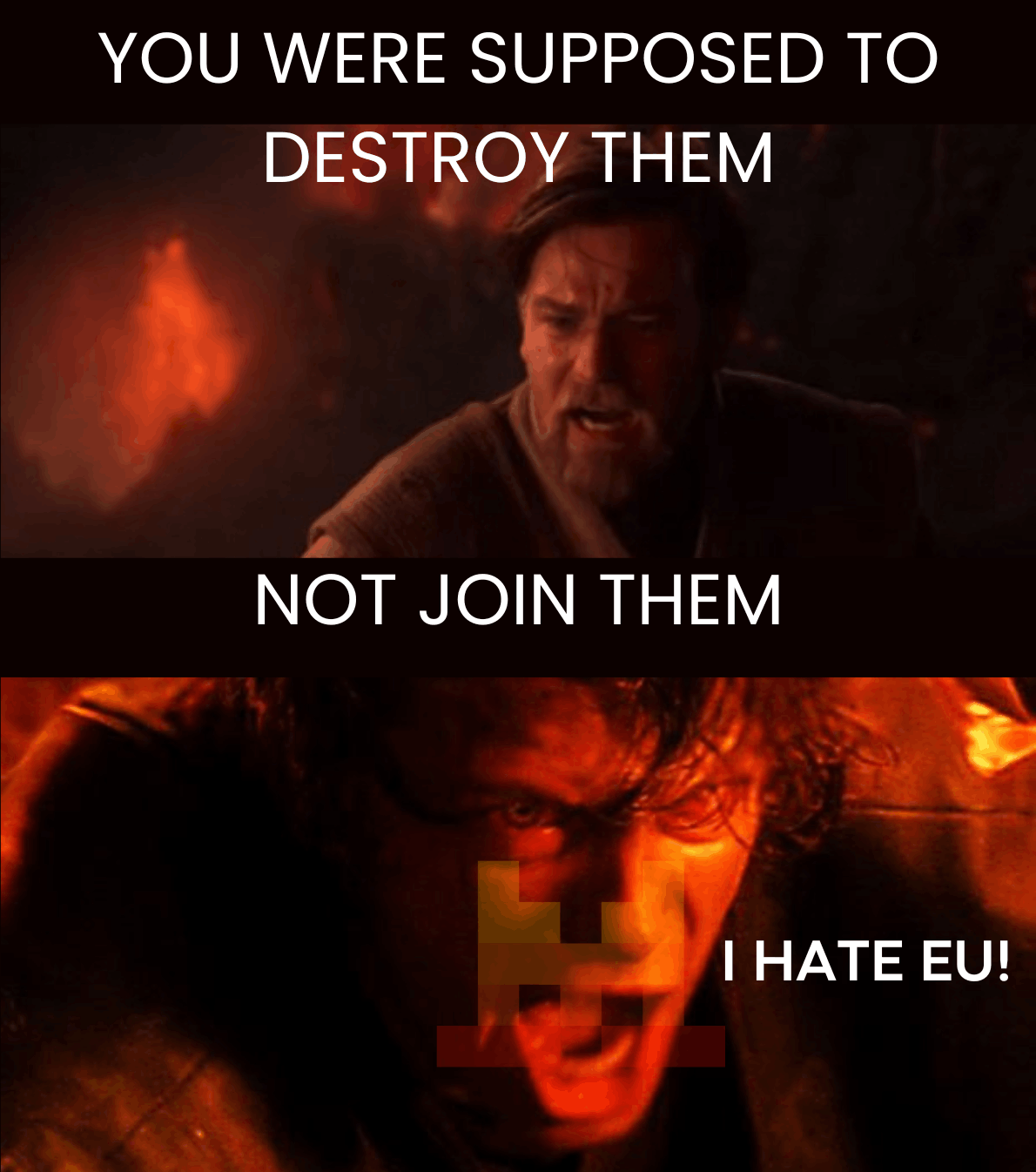
Let’s be intellectually honest. This isn't about being a "purist", it’s about Infrastructure Integrity. If you build a "European Champion" on top of a US foundation, you haven't built a champion; you've built a sub-contractor.
-
The "Captive Tenant" Trap: Mistral is building its house on land owned by Microsoft, Google and Coreweave. This makes them a captive tenant, permanently subject to the pricing, terms, and infrastructure decisions of their direct rivals. Moreover, if they try to switch to a sovereign alternative, it is a process that takes years, not something that can be done overnight.
-
The Privacy Premium: Intellectual property (IP) is Europe’s greatest asset. A "good enough" solution that leaks your secrets via the US CLOUD Act is actually a bad solution.
-
Killing Innovation: Blindly accepting US-hosted "European" tech removes the incentive for Mistral to move to sovereign clouds. It signals to startups like Euclyd that we don't care about the hardware they are working so hard to build.
Real pragmatism isn't ignoring a hole in your boat because the boat was made in Paris. Real pragmatism is fixing the hole so you don't sink.
The Hardware Gap: A Decoupled Reality
A common "gotcha" is: "But everyone uses US chips!" There is a difference between using a chip and renting a cloud.
-
The Data Path (The "Now" Problem): Even if you use an NVIDIA chip, your data does not have to leave Europe. The issue with Mistral today is that the Infrastructure Layer (Azure/Google) is American.
-
The Silicon (The "Future" Solution): Europe is fighting back. Dutch startup Euclyd has unveiled its CRAFTWERK architecture, a 100% European-designed inference engine that challenges NVIDIA’s dominance. In the near future, Europe's AI model providers may be able to run on Euclyd hardware. This would mean that Europe would no longer be fully dependent on the US for hardware.
The Path to 2026: Why There is Hope
Their strategic move into the European AI infrastructure market, featuring 18,000 Grace Blackwell chips with Eclairion/Fluidstack partnership offers a light at the end of the tunnel. It proves they want to bring AI inference to Europe and that they have a clear sight of the finish line.
By late 2026, the Mistral's European data sovereignty could become a reality for ordinary users too, not just top enterprise users. This would mean that data could finally stay in Europe, ensuring the intellectual property of European citizens and small European companies is finally protected. Until then, however, there is still a long, tough road ahead.
What you can do now
First of all, if you want to continue using Mistral and want to confide your private chats to US companies, you can opt-out of training to mitigate some risks, or you can switch to a provider that solves the infrastructure problem today.
-
How to opt-out of Mistral Training
If you are committed to using Mistral's direct interface, you must secure your data immediately because model training is enabled by default:
-
- Go to your Mistral Account Settings.
-
- Navigate to the "Data & Privacy" section.
-
- Toggle OFF "Train on my data" or "Improve Mistral models".
-
- Be aware: This does not solve the US Cloud Infrastructure issue (CLOUD Act), but it stops your chats from directly training the model.
The drawback? You are still routing traffic through Cloudflare and chats through US hyperscalers, leaving your IP address exposed and your metadata, chats, and documents subject to US surveillance laws.
-
Switch to real european alternatives
While awaiting Mistral's decoupling from the US, a solution is already available for those seeking immediate access to European data sovereignty.
Lumo offers a robust, Swiss-based solution. It's not an EU project, but at least European! Lumo might try to lock you into the broader Proton ecosystem. Additionally, privacy advocates have noted that Swiss surveillance laws are no longer as absolute as they once were. Lumo's use of a European tech stack is a significant advantage, as it avoids collaboration with major US and Big Tech providers.
xPrivo For users seeking a frictionless, account-free experience protected by strict EU jurisdiction, xPrivo (Luxembourg) offers a compelling alternative and it offers a practical middle ground. It provides access to advanced models (including Mistral!) while maintaining strict European infrastructure that is independent of major technology companies. For those who don't care about US tech and require the capabilities of US AI models without the privacy risk, there is an option to upgrade to the PRO version, which allows access to models such as Gemini and GPT-5.2. You will continue to receive the xPrivo shield, which means that your chats will not be used for training purposes. However, it should be noted that Gemini will send your data to Google and GPT-5.2 to Microsoft, in a similar manner to Mistral. Did you know? Google automatically uses your chats with their AI assistant, Gemini, to train their new models when you use Gemini over their platform, even if you are a paying subscriber (Basic, Plus, Pro, Ultra)? Yeah, it's because of that why we integrated this into xPrivo, to also help those users seeking a bit more privacy while still using Gemini. When you use Gemini over their platform, you are literally paying twice, once with your data and once with your money, what a nice lucrative business idea. You can read more about that here: Google admits reading your chats with Gemini
And for those totally paranoid, xPrivo is open-source, you can run it on your own consumer hardware at home and keep your data fully offline while chatting with a small Mistral model that you connect with Ollama.
Here is how xPrivo protects what the current Mistral setup exposes:
-
Zero Training Policy: Your data is never used to train future models.
-
Zero Training Policy: No storage of your chats. Everyting stored offline on your device.
-
No Account Required: Eliminating the tracking of user identity.
-
European Stack: Independent of Big Tech by default.
-
Anonymous PRO: Even if you upgrade, you remain anonymous.
Drawback of xPrivo: Because xPrivo prioritizes anonymity by eliminating user accounts, there is no automatic cloud sync. Your conversations are stored locally on your device, not on a central server. If you want to pick up a chat on a different device, you will need to manually export and re-import the file—a deliberate friction point designed to ensure that you remain the sole custodian of your data.
By using xPrivo, you get the linguistic quality of Mistral without the US data trail. It is sovereignty by default, not by promise.
Head over to xPrivo.com and try it out for free.
The Bottom Line
If you want to support European technology, continue using Mistral but don't delude yourself into thinking the job is done. Remember that you are currently a guest in a US ecosystem, subject to US political shifts and decisions. As long as the infrastructure is American, the US CLOUD Act grants authorities potential access to your private chats and documents that you shared with Mistral.
If you are switching to European alternatives, you should oppose the status quo, rather than embrace it. This demonstrates to companies like Mistral that there is demand for European digital sovereignty. This will lead to the progress and improvements that Europe really needs, and will eventually help them to transition.
The "Google Ireland" Paradox: Why Not Just Use the Real Thing?
Finally, for the die-hard defenders who insist that "Mistral is sovereign because it is a European company", let’s follow that logic to its inevitable conclusion.
If your definition of "European Sovereignty" is simply having a headquarters on EU soil while running entirely on US infrastructure, then why not just use Google Gemini?
For all users in the EU, the service provider for Gemini is Google Ireland Limited, a company headquartered in Dublin, subject to Irish law and the GDPR.
-
Mistral: A French company running on US servers (Azure/Google/Coreweave/Cloudflare).
-
Google Ireland: An Irish company running on US servers (Google).
If you are going to use a model that pipes your data to American hyperscalers anyway, you might as well use the one that admits it. Defending Mistral as "sovereign" while attacking Google is not patriotism; it is a double standard.